Short report of the International Student Conference of the
“Borjan Tanevski Memorial Fund” held in Skopje, 12th June 2004
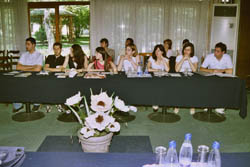
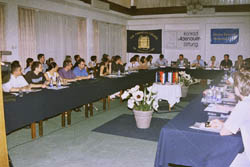 On the Conference were present about 50 participants: students and professors from the University in Skopje, the American College of Thessaloniki (ACT), the SEE University in Tetovo, students from Bulgaria and Slovenia, representatives of the Sector for European Integration of Republic of Macedonia, “Konrad Adenauer Foundation” scholars and staff, young activists and Tanevski family. The conference was opened and chaired by Andreas Klein, director of “Konrad Adenauer Foundation” in Skopje.
The participants have convened and discussed the issues present in the winning essays of the “Borjan Tanevski Memorial Fund” from the American College of Thessaloniki competition 2004. This year’s subject of the competition was: “Does the European Union offer a prospect  for lasting peace in South-East Europe?” Prof. Dr. Mueller presented the essay winner for 2004 - Ms. Biljana Meskovska, an ACT student. Presenting her paper, she explained her statements and visions for EU integration of SEE. Ms. Samarova Martina, short listed participant of the competition, also presented her paper.
The final discussion, was led by Ales Vidmar, a Slovenian studying at the Central European University in Budapest. There were six short presentations by Edvard Mitevski from the Sector for European Integration of Republic of Macedonia, Elena Angelovska from MMUN, three students from the Law Faculty in Skopje post-graduate International Relations program - Adilovic Esma, Lajmanovska Biljana, Spasoska Bojana, and Sokolovska Ivana from the Institute for Democracy and Solidarity in Skopje.
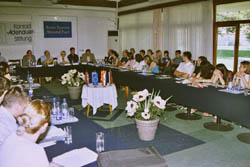 In the free discussion many issues have been addressed. Overall the debate was on a high level and has touched upon the key issues Republic of Macedonia and other Balkan states are facing as they are making the first steps towards EU accession. Often it was mentioned that World War II recovery and normalization could serve as an example that it is possible in the Balkans. However, there are many differences, and although EU can serve as a light at the end of the tunnel, these people need to walk through the tunnel themselves by pursuing the road of peace and reform.
The students overwhelmingly agreed and backed the idea that peace is a priority for their country’s political agendas. Nevertheless, it is intertwined with economic growth and prosperity. That is where EU and its members could play an active part, EU by providing developmental funds for infrastructure improvement while its members could invest into the economy. There is still a pessimistic attitude youth faces as a result of low incomes or low rate of job opportunities. Continuation of this state might be a reasonable threat to the desired effect of peace and prosperity.
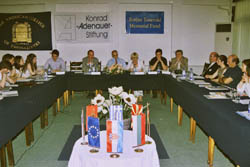 Many of the questions and comments addressed the issue of getting funds from EU, allocating them optimally, while there was a sense of feeling that it is not transparent (known) enough in Republic of Macedonia, namely how much funds there are and how they are spent. Some comments have rightly stated that it is not only how much, but how usefully the money is spent. Balkan countries should not expect the magic developmental formula from the EU, but from their own leadership and administration – to develop the country according to the greatest needs and opportunities available. Another issue discussed was how to articulate: exactly what does the EU need from the region and what can the region offer to EU.
 Throughout the debate there was a strong feeling of enthusiasm shown for EU integration and the idea was that this could finally unite the divided region into having similar goals on their political agenda. This could finally change the dictionary connotation of the word Balkan, mentioned in the winning essay, which implies that Balkan is antagonistic into a changed meaning of being a cooperative EU region.
Conclusions:
The meeting was a success and has provided a great opportunity to discuss and find the main issues that today’s youth from the Balkans finds necessary:
 Vision and Strategy
EU provides an attractive goal for the youth and their countries to work for. EU should be engaged to motivate and stimulate the productive youth activity. Balkan countries should support them by working together for that goal and employing young people to learn and to provide information about EU accession to the population. A yearly young leaders’ and students’ seminar taking place in Skopje could provide a great channel to distribute these ideas, problems and solutions.
Projects and Funds
As one of the topics touched upon the structural funds and fundraising, these countries need to increase the level of transparence about what funds are actually received, how they are spent and on which projects. Events as ours give an opportunity to have reports on what exactly is being done by the European Integration Sectors across the countries, on the other hand they have the capacity building dimension as the young organizers learn how to raise funds, handle logistics, communicate etc.
Role of Youth
Youth is our bridge to the future and has to participate and learn today already. With projects like ours we experience a confrontation of ideas and new ideas take shape. We get a hands-on-experience of what are their dilemmas and how to find solutions. Youth needs to develop their skills and which is possible by organizing these events. They also acquire the skills in political and economic vocabulary, oration skills and in communication that will enable them to take a more efficient and articulate position in their interactions with Western partners.Because of this year’s success and the several initiatives to repeat the event the seminar will be continued in the next year, with an increased international representation and longer period of duration.
Skopje, 12th June 2004
Prepared by:
Ales Vidmar